«God, do not let me get used to fear»
2026
This work is not about a specific country.
It is about the fact that childhood should not be measured by the distance to the front line or by the number of small steps to a bomb shelter during air raids.
It is about a world that has taught children to be afraid and must at least be willing to hear their prayer.
For me, working with domestic embroidery is a way of engaging with collective memory. I use found textiles as cultural carriers that already embody a certain ethic and aesthetic. My intervention does not destroy this history; rather, it seeks to activate it and translate it into a contemporary context at least, that is my intention.
«Боже, не дай мені звикнути до страху»
2026
Ця робота не про конкретну країну.
Вона про те, що дитинство не повинно вимірюватися відстанню до фронту чи кількість маленьких кроків до укриття від повітряних атак..
Вона про те, що світ, який привчив дітей боятися, має принаймні почути їхню молитву.
Практика роботи з побутовими вишивками для мене є способом взаємодії з колективною пам’яттю. Я використовую знайдені текстилі, як культурні носії, що вже описують певну етику та естетику. Моє втручання не руйнує цю історію, а актуалізує її, переводить у сучасний контекст, принаймі, я прагну до цього.
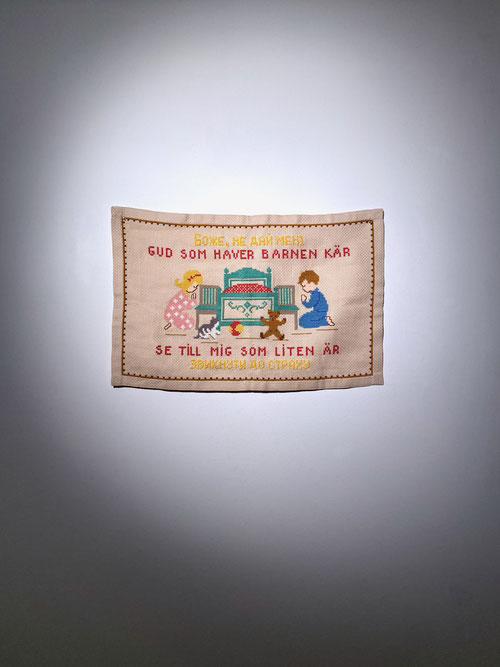

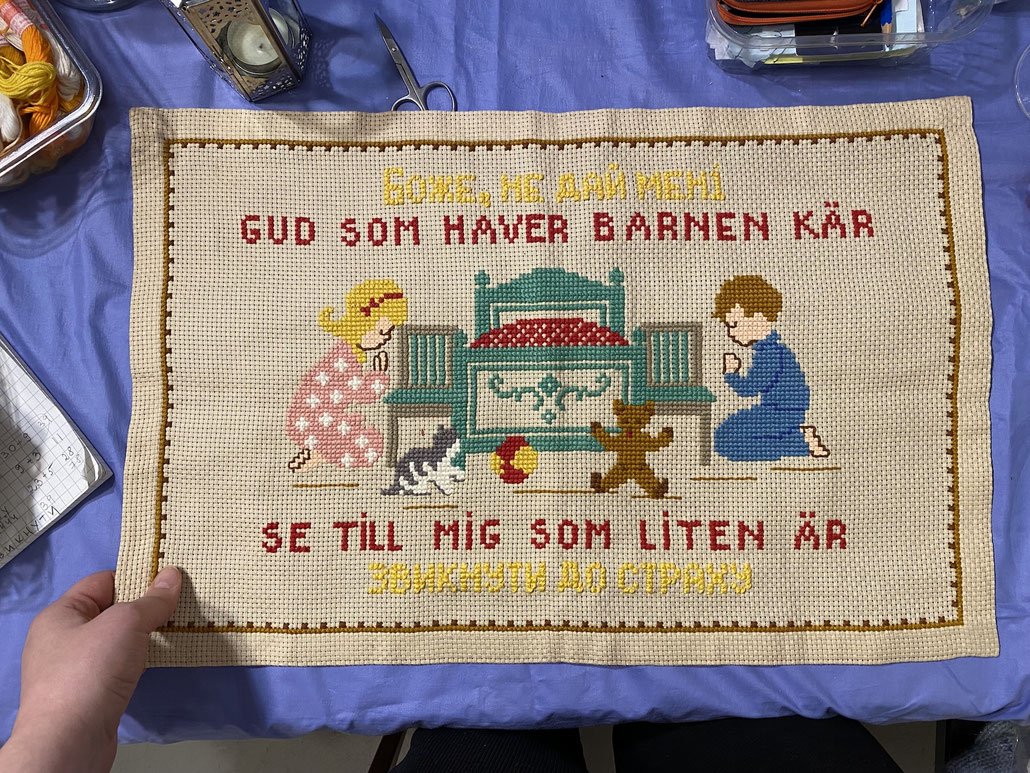
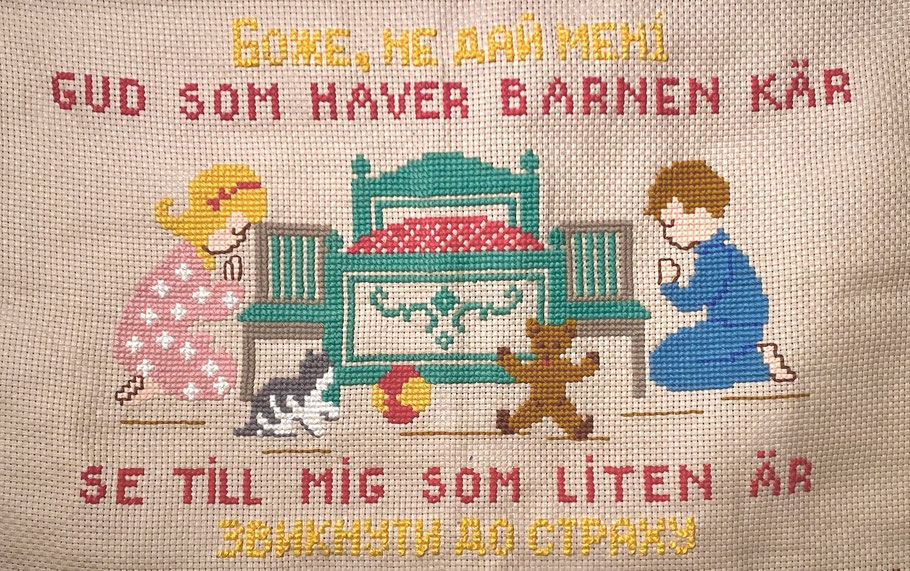
This work is based on a found domestic embroidery that belongs to the Swedish tradition of prayer textiles used as home décor. Such cross-stitched pieces on canvas were common throughout the twentieth century and often decorated children’s rooms. They featured fragments of the well-known prayer “Gud som haver barnen kär” (“God, who loves the children”), which children traditionally recited before going to sleep.
The text functions as a request for protection and care: God, who loves the children, may He watch over the little ones. The phrase symbolizes a stable world in which childhood implies safety.
In this work, I do not destroy the original image or cross out the tradition. My intervention is minimal: I add a new phrase in Ukrainian: “God, do not let me get used to fear.” This text appears between the lines of the Swedish prayer, like the voice of a contemporary child living in the conditions of war.
A prayer about love becomes a plea to preserve the ability to feel. During war, fear transforms into everyday reality, and the most dangerous thing is not fear itself, but becoming accustomed to it. Becoming used to living in war. Becoming used to violence. Habit means the normalization of violence : the acceptance of danger as a new natural environment.
Although the Swedish prayer and the Ukrainian text coexist on the same textile creating a space of dialogue between protected childhood and childhood shaped by military reality, and even functioning as a coded reference within certain confessional traditions, my work addresses something universal that we too often forget: every child’s life is valuable, regardless of borders, languages, or cultures.
Ця робота створена на основі знайденої побутової вишивки, що належить до шведської традиції молитов на текстилі, що є домашнім декором.
Подібні вишивки, виконані хрестиком на канві, були поширені у ХХ століть та прикрашали дитячі кімнати. Вони містили фрагменти відомої молитви «Gud som haver barnen kär» / «Боже, що любиш дітей», яку діти традиційно промовляли перед сном.
Текст звучить, як прохання про захист і турботу: Бог, що любить дітей, нехай оберігає маленьких. Ця фраза є символом стабільного світу, у якому дитинство передбачає захищеність.
У цій роботі я не знищую первісний образ і не перекреслюю традицію. Лише мінімальне втручання, додаючи нову фразу українською: «Боже, не дай мені звикнути до страху». Цей текст з’являється між рядками шведської молитви, як голос сучасної дитини, яка живе в умовах війни.
Молитва про любов стає молитвою про прохання зберегти здатність відчувати. Бо під час війни страх трансформується у повсякденність, і найнебезпечніше це звикання до нього… Звикання жити у війні.. Звикання означає нормалізацію насильства, прийняття небезпеки, як нового природного середовища.
І хоча шведська молитва і український текст співіснують на одному полотні, створюючи простір діалогу між безпечним дитинством і реальністю дитинства під час воєнних дій, та є кодом для певних конфесій, — я звертаюсь до універсального людського сталого поняття, про яке хіт забуває: кожне життя дитини є цінним, незалежно від кордонів, мов чи культур.