“Return”
Gesture-object “Return”
2026
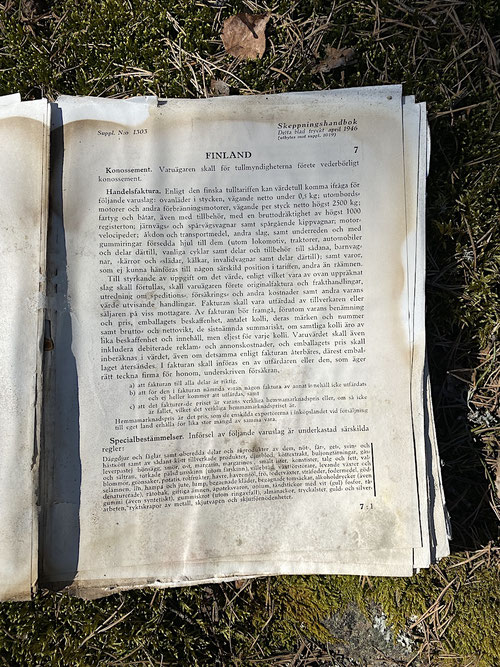
navigation book, moss
This artist’s book, or gesture-object, is an attempt to trace the gradual escape of matter from the control of a human system that seeks to record and organize the world. The book ceases to function as a carrier of knowledge and re-emerges as a material object returning to the natural cycle.
The found book, already partially destroyed by time, continues its process of decay. Moss, as a living organism, not only covers its surface, but seems to displace the very principle of ordered knowledge.
This is not an act of destruction, but a shift of roles and meanings, a transfer of control to the environment.
I attempt to find answers to the following questions:
what happens to knowledge when its structure begins to dissolve?
can memory survive the destruction of its carriers?
“Return” is a gesture in which the book ceases to be a cultural object and becomes part of the landscape once again.
This book was once a navigation manual for a complex route through the Baltic Sea and the Gulf of Bothnia, and therefore this gesture-object acquires another dimension. It is not only about the transformation of knowledge, but also about the loss of orientation. The instruction that was meant to indicate the way can no longer perform its function. Routes become indistinct, the system of coordinates collapses. In this case, moss acts not as a covering, but as a system bug: it does not lead forward, but spreads into multiplicity, depriving the structure of center and purpose.
The control over space implied by navigation gives way to the autonomy of the environment: the landscape is no longer described by the book, but rewrites it. In this gesture, “return” ceases to be movement toward a known point and becomes an acceptance of a situation in which the path itself becomes secondary.
Thus, in the end, a book created to understand direction and rules begins to lose faith in the very necessity of its own existence.
Жест-обʼєкт "Повернення"
2026
навігаційна книга, мох
Цей артбук або жест-об’єкт є спробою простежити поступовий вихід матерії з-під контролю людської системи, що намагається фіксувати й впорядковувати світ.. Книга перестає функціонувати як носій знання і знову постає як матеріальний об’єкт, що повертається у природний цикл.
Знайдена книга, вже частково зруйнована часом, продовжує свій розпад. Мох, як живий організм, не лише покриває її поверхню, але наче витісняє сам принцип впорядкованого знання.”
Це не акт знищення, а зміна ролей та сенсів, передача контролю середовищу.
Я намагаюся знайти відповіді на питання:
що відбувається зі знанням, коли його структура починає розчинятися?
чи здатна пам’ять пережити руйнування своїх носіїв?
"Повернення" - це жест, у якому книга перестає бути культурним об’єктом і стає частиною ландшафту. Знову.
Ця книга колись була навігаційним посібником по складному маршруту Балтійським морем та Ботнічною затокою, тож зараз цей жест-обʼєкт набуває ще одного виміру. Він не лише про трансформацію знання, а й про втрату орієнтирів. Інструкція, що мала вказувати шлях, більше не може виконувати свою функцію. Маршрути стають нечіткими, система координат руйнується. Мох у цьому випадку діє не як покрив, а як баг системи: він не веде вперед, а розростається у множинність, позбавляючи центру та цілі.
Контроль над простором, який передбачає навігація, поступається автономії середовища: ландшафт більше не описується книгою, а переписує її. У цьому жесті (об'єкті) повернення перестає бути рухом до відомої точки і стає прийняттям ситуації, в якій сам шлях набуває другорядності.
Таким чином, зрештою, книга, створена для розуміння напрямку та правил, починає втрачати віру у саму необхідність власного існування.


Looking through the photographs taken during the gesture of “Return,” I realized that it was not the finding of a book, but an encounter with it…
After translating into my native language the two pages I had opened at random during this “encounter,” I discovered that one was about Finland, and the other about the Soviet Union.
I did not deliberately search for these pages. It was a coincidence.
Of course, a coincidence, if one believes in coincidences…
So, from the outside, I saw it like this:
a Ukrainian artist who, through a chain of events caused by russia’s war against Ukraine, finds herself on an island in the Baltic Sea, encounters in April 2026 a navigation guide printed in April 1946, several years after the end of Finland’s two wars with the Soviet Union… while having lived her entire life with the conviction that the era of the ussr was an era of occupation for Ukraine.
And now, eighty years later, history appears before me once again… Not in archives. Not in a museum. But in a forest on one of the islands of the archipelago of south-western Finland…
Indeed, quite by chance…
I thought about this a lot, and even drew a chain for myself: how cause-and-effect relations created this “encounter.”
But what interests me here is not the coincidence itself, nor its mystical component. I began to think about the moment when coincidence becomes part of an artistic statement, creating new or additional meanings.
A feeling as if some things cannot be left in the past… They continue to emerge in unexpected places, landscapes, biographies…
And so this navigation guide ceased to be a “found object.” It became a participant in events: a participant in creation, a co-creator of the artistic work, a participant in my life…
Переглядаючи фото, зроблені під час жесту «Повернення», усвідомила, що то була не знахідка книги, а зустріч з нею…
Переклавши на рідну мову дві сторінки, які навмання відкрила при «зустрічі», зʼясувала що одна про Фінляндію, а інша про радянський союз.
Я не шукала навмисно ці сторінки, це випадковість.
Звісно, - випадковість, якщо вірити у випадковості….
Тож, зі сторони я побачила це так:
українська художниця, що через сплетіння подій, викликаних війною росії проти України, опиняється на острові Балтійського моря, зустрічає у квітні 2026 року навігаційний довідник, надрукований у квітні 1946 року, після декількох років закінчення двох війн Фінляндії з радянським союзом….. живучи все життя з переконанням, що доба ссср - окупаційна доба для України.
І от, через вісімдесят років історія знову виникає переді мною… Не в архівах. Не в музеї. А у лісі на одному з островів архіпелагу південно-західної Фінляндії…
Дійсно, досить випадково ...
Я багато думала про це, навіть малювала для себе ланцюжок: як причинно наслідкові зв’язки створили цю «зустріч».
Але в цьому мене не цікавить сам збіг, чи його містична складова, я замислилась над моментом, коли випадковість стає частиною художнього висловлювання, створюючи нові або додаткові сенси.
Відчуття, наче деякі речі неможливо залишити в минулому.. вони продовжують виникати в неочікуваних місцях, ландшафтах, біографіях..
Тож, цей навігаційний посібник перестав бути "знайденим об'єктом», він став учасником подій: учасником творення - співтворцем мистецького , учасником мого життя..